Friday, August 6, 2010

switzerland and swiss airline wallpapers

switzerland and swiss airline pic
switzerland airline
switzerland
switzerland and swiss airline
switzerland and swiss airline wallpaper

swiss airline pictures

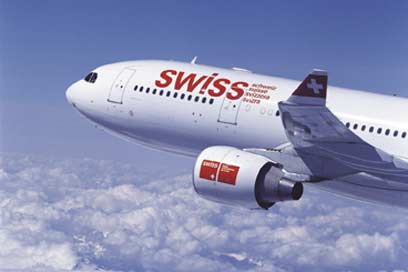
Swiss International Air Lines AG (short: Swiss) is the principal airline of Switzerland operating scheduled services in Europe and to North America, South America, Africa and Asia. Its main hub is Zürich Airport (ZRH).

Swiss is a subsidiary of the German airline Lufthansa. It is headquartered at EuroAirport Basel-Mulhouse-Freiburg near Basel, Switzerland. Swiss also has an office at Zürich Airport in Kloten, Switzerland.[3] The company's registered office is within the city of Basel.[4]

The airline uses the IATA Code LX that it inherited from the Swiss regional airline Crossair (Swissair's code was SR). The ICAO code is SWR, inherited from Swissair (Crossair's was CRX), in order to keep international traffic rights.
swiss airline set
swiss airline image
swiss airline
swiss airline pic
swiss airline picture
The airline was formed after the 2002 bankruptcy of Swissair, Switzerland's former flag carrier. The new airline's losses totaled $1.6 billion from startup until 2005. Swissair's biggest creditors, Credit Suisse and UBS, sold part of Swissair's assets to Crossair, the regional counterpart to the transatlantic Swissair (both Swissair and Crossair were under the same holding company, called SAirGroup). Crossair later changed its name to Swiss, and the new national airline started its operations officially on 31 March 2002. The airline was first owned by institutional investors (61.3%), Swiss Confederation (20.3%), cantons and communities (12.2%) and others (6.2%). Swiss also owns subsidiary companies Swiss Sun (100%) and Crossair Europe (99.9%). It has a total of 7383 employees.[5]
Airbus A340 at Narita Airport, Japan

Swiss International Air Lines, or "Swiss", was founded from the remains of Crossair. Crossair had 40% of its income come from the defunct Swissair. The first year was plagued with loss and the Swiss government gave the airline the then-equivalent of $1.5 billion, which was used up within two years.

According to Marcel Biedermann, the managing director intercontinental markets for Swiss, there were three possibilities: stay independent as a niche carrier, shrink to an unrecognisable level, or attach onto another airline group. The last choice was taken. Swiss talked to Air France-KLM, British Airways, and Lufthansa. However, Swiss was tied up with debt and an uncertain future, and seemed to be an unattractive investment. After merging with KLM, Air France said they were too busy to deal with Swiss joining them. Lufthansa wanted to take over, but the Swiss people did not want that. British Airways was open, and Oneworld partners thought Zürich Airport would be a viable alternative hub for London Heathrow.

After almost a year of disputes, Swiss was finally accepted into the Oneworld airline alliance, after having been blocked by British Airways, which competes with Swiss on many long-haul routes. On 3 June 2004, Swiss announced its decision not to join Oneworld because they did not want to integrate their current frequent flyer program into British Airways' Executive Club. Furthermore, Swiss thought the relationship was one sided, where British Airways sapped out the benefits of the airline, but they would get no return.
[edit] Recovery
A Swiss A340
Sanno Park Tower Annex, which has the Swiss House (スイスハウス Suisu Hausu), the Japanese offices of Swiss International Air Lines, in Chiyoda, Tokyo

The airline annually halved its losses, and in 2006 received a net profit of $220 million. The net profit for 2007 was $570 million. Biedermann stated in the March 2008 edition of "Airways", that "this was the beginning of getting our house back in order." He said that help was needed and looked up to Lufthansa as a comparison, so their coming together was natural, even with their differences. Even with the smaller network, Swiss carries the same number of passengers as they did in 2002.

On 22 March 2005, Lufthansa Group confirmed its plan to take over Swiss, starting with a minority stake (11%) of a new company set up to hold Swiss shares called Air Trust. The takeover was completed on the 1st of July 2007 and the Swiss operations were gradually integrated with Lufthansa's from late 2005. Swiss joined the Star Alliance on 1 April 2006, when it also became a member of Lufthansa's Miles and More frequent flyer program.

The airline has set up a regional airline subsidiary called Swiss European Air Lines. This carrier has its own air operator's certificate and operates a non-Airbus fleet. The two independently operating divisions Swiss AviationTraining and Swiss WorldCargo (belly capacity of passenger planes) are also owned by Swiss.

In 2008 Swiss International Air Lines acquired Edelweiss Air[6] [7] and Servair[8] - now Swiss Private Aviation.

The Swiss brand still retains a high respect with travellers, as can be seen by the company coming top of the upmarket Condé Nast Traveller readers' survey[9] for short haul flights in 2008.

In 2007, Swiss placed order for 9 Airbus 330-300 aircraft to eventually replace the existing fleet of its 9 A330-200 aircraft. The A333 would be more environmentally friendly and have 3-class seating. With each arrival of an A330-300 jet which began in April 2009, one A330-200 will be retired from the fleet. The first A330-300 jet was put into service from Zurich to New York (JFK). As of spring 2010, Swiss operates five A330-300s on routes from Geneva to New York (JFK), as well as Zurich to New York (JFK), Delhi, Mumbai, and Dubai & Muscat. As of April 2010, the A330-300 will fly from Zurich to Nairobi & Dar es Salaam and Yaoundé & Douala. The remaining order of A330-300 aircraft will be joining the fleet by 2011

Tuesday, August 3, 2010

hajj airline images

The minister of religious affairs on Friday waved off the first of this year’s Indonesian hajj pilgrims and sought to calm worries that pilgrims could have problems with accommodation in Saudi Arabia caused by a last-minute building-code rule issued by Riyadh.

“I guarantee that all pilgrims will get lodging,” Suryadharma Ali said after seeing off 1,355 travelers at Soekarno-Hatta International Airport.

The Saudi government last week issued a regulation requiring all buildings of at least four stories and housing more than 250 people to provide emergency exit stairs. The regulation was issued after all Indonesian government lease contracts had been finalized with building owners.

But Suryadharma said the government had asked Saudi Arabia to reconsider its building-standard regulation.

Abdul Kadir Karding, chairman of House of Representatives’ Commission VIII for religious affairs, social affairs and women’s empowerment, vowed that a 25-strong House team would fly to Saudi Arabia to ensure the minister kept his promise that all pilgrims would be lodged properly.

Suryadharma said the government had already rented spare buildings in anticipation of problems.

Abdul Ghafur Djawahir, director for the administration of the hajj pilgrimage, said Saudi Arabia had already responded to the Indonesian request and said it would accommodate Indonesian needs “by letting us house fewer than 250 pilgrims in every lodging.”

He said that initially, about 19,000 pilgrims might have been affected by the new building regulation, but the approval of the Saudi government had greatly reduced the number.

Meanwhile, the head of the West Sumatra religious affairs office, Darwas, denied rumors circulating that pilgrims from Padang were sleeping in tents. Darwas said all the pilgrims, who will be flown in batches between Saturday and Nov. 16, were in the local hajj dormitory, which was undamaged by the Sept. 30 quake.

He also said that not one of the 7,500 pilgrims registered in Padang had canceled their trip.

The government provides all-inclusive hajj packages that cover transport, accommodation and meals. Indonesia is this year sending 207,000 hajj pilgrims, including 16,000 who are taking part under the more luxurious of the two package options.

Solo, Central Java, will send the highest number of pilgrims, with 33,038, followed by Jakarta with 21,951.

State-owned airline Garuda Indonesia will fly more than 114,000 hajj pilgrims this year from 10 cities, using 15 wide-bodied aircraft, company spokesman Pujobroto said in a statement.
hajj airline
hajj airline
hajj airline
hajj airline
hajj airline

Monday, August 2, 2010

The top Bahamas Airlines images

Bahamas Airline
The Bahamas
The Bahamas Airline
Bahamas Airlines map
The Bahamas Airlines map

The Bahamas Airlines pictures

BAHAMASAIR, the new Government-backed national airline of the Bahamas flew its first services on Monday, nearly two weeks ahead of its July 1 target date.

The carrier has taken over all domestic links from Out Island Airways and Flamingo Airlines, and is operating the Bahamas to Miami service with a BAC One-Eleven.

Dann Lewis, assistant director of the Bahamas Ministry of Tourism and chairman of Bahamian Air Carrier Holdings, Ltd., parent company of the airline said in London that the short term goal was to provide the islands with stable air services .

Dann H. Lewis confirmed that the carrier plans to acquire two or more One-Elevens, the second of which goes into service on August 1, and eventually resume more of the old Bahamas Airways services to Florida.

from: Nassau Guardian, June 1973
Bahamas Airline
The Bahamas Air
The Bahamas
The Bahamas Airline
Bahamas Airline

Tuesday, July 27, 2010

water airplane pictures

During the winter months, runoff from waste water contaminated with glycol is produced when planes are de-iced. In the winter of 2005 – 2006 the waste water contaminated with glycol was collected and stored at various locations at Schiphol airport. The concentrations of glycol varied from 3% to 10%. In the past, waste water containing glycol was discharged to external treatment plants. Schiphol no longer regards this as desirable and has contacted Evides Industrial Water in connection with this specific waste water problem. As the operator of the existing Schiphol waste water treatment plant located at Schiphol-Oost, Evides was happy to work on developing a solution to this waste water problem.
Picture of an airplane
Action plan
Evides Industrial Water conducted market research on the possible techniques for treating waste water contaminated with glycol. In the United States and Canada, concentrators are widely used for the physical treating of such water. Evides Industrial Water presented an action plan to Schiphol that calls for using a concentrator to concentrate water containing glycol into an end product that can be used as a raw material for industrial processes. Killfrost type 2, the de-icing product used during the winter of 2005/2006, contains additives, including polymers. The type 2 de-icer is used at Schiphol because of the longer distances plans must taxi to reach the runways for takeoff. Inland Technologies, which supplies the concentrator, had no experience with this type of de-icing product. Inland Technologies saw the effects of the additives in the type 2 de-icer as a problem in terms of clogging and dirtying, and because of this could not guarantee that operations would be done efficiently and economically. It was necessary to pre-treat the de-icer before use to remove the polymers.

Pre-treatment and test location
Prior to a full-scale test, the de-icer was subjected to ultra-filtration to separate out the polymers. On the basis of financial and operational considerations, this pre-treatment was not selected. On the basis of robustness of technology and lower operating costs, a coagulation/flocculation pre-treatment was selected. During the period from May until September of 2006, a glycol concentrator for pre-treatment was erected on the Schiphol grounds and the full-scale test was performed. The treatment capacity of the installation was approximately 20 cubic metres daily, depending on the glycol concentration in the waste water. The amount of runoff of wastewater contaminated with glycol is strongly influenced by weather conditions. In the winter of 2005/2006, approximately 10,000 cubic metres of waste water contaminated with glycol (in both high and low concentrations) were produced. The high concentrate was worked up with the concentrator and the low concentrate was treated biologically in the aerating ponds built by Schiphol.

Conclusions
During the period from May until September of 2006, Evides Industrial Water was commissioned by Schiphol to operate the concentrator for pre-treating. The following results were achieved:
- Treating of the waste water contaminated with glycol is feasible using a combination of the concentrator and a coagulation/flocculation pre-treatment.
- The end product is of a commercial quality and will be used subsequently as a raw material in industrial processes.
- Following an aerobic post-treatment, the residual product is suitable for discharge to surface water.

And further
Evides has been awarded a subsequent contract by Schiphol to continue operating the concentrator and the aerating ponds for the coming year.


water airplanec wallpaper
water airplane image
water airplane pic
water airplane
water airplane

Monday, July 26, 2010

airlines uniform pictures

Starting with the first of the year, Czech Airlines' (ČSA) staff greets its customers in their new uniforms. After more than 9 years, the national carrier had decided to change the design of its uniforms and its two-and-a-half-thousand employees are about to get a new elegant look. The new uniforms and their accessories are in the airline's colours – blue, red and white – and it is hoped that their bold designs will make it easier for passengers to identify the staff that is taking care of them during their air travels. The domestic apparel manufacturer OP Prostějov was the winning bidder in the spring 2005 tender for the supply of these new uniforms. After more than 9 years using the existing uniforms, ČSA decided to give its staff a new appearance and announced a tender for a new supplier in the spring of 2005. Of the four participating bidders, the review committee determined that OP Prostějov, a Czech manufacturer of women's and men's apparel with a long tradition, had come up with the most favourable bid. The winning bidder proposed a new uniform collection that would not only be elegant and stylish but also one in which special attention would be paid to the materials used to make the uniforms. "When creating this new collection, we used the latest European knowledge and expertise in the area of production technologies. Because of the strict demands for the durability and ease of maintenance of the materials to be used, we finally opted for nanotechnology based fabrics. Similar fabrics were also used by the famous French designer Christian Lacroix in his collection of uniforms designed for Air France," said Bořivoj Klug, head of design and sales for corporate identity projects at OP Prostějov. Besides choosing a new elegant design, the selection of the new uniforms also involved considerations such as the comfort and any health impact on the wearer, water resistance, durability, a wrinkle-free appearance, colour fastness and tear resistance. The initial designs for the uniforms underwent several months of testing in all primary operating areas of the company's operations. Description of the New Uniforms The main element of the uniform is a dark blue suit evoking a natural air of authority and professionalism. The rudimentary appearance of the blue colour is softened with red accents, which give the uniform a dynamic look and make it visible in crowded airport environments. A variety of accessories are also used to differentiate between the different staff positions. Pilots wear a gold-coloured necktie and the staff of VIP services wears uniforms with silver-coloured accessories. The designers paid a great deal of attention to even the smallest details and the decorative aspects of the new designs. An important decorative element is the diamond shaped symbol, the primary graphic identity logo for Czech Airlines. Its shape can be seen in the lines of the uniforms' cut, on the printed design on the scarves, shirts and on the buttons for the jackets. The sparkling Swarovski stones that decorate the women's jacket pockets have also been a successful part of the new designs. Czech Airlines introduced its first uniforms back in the 1920's, shortly after the start-up of the airline. The use of uniforms slowly spread from pilots to stewards and, by today, the use of uniforms includes check-in staff, ticket agents, security officers, technicians and other ground service workers. The new collection from the workshop of OP Prostějov features not just a modern design and cut for both men and women and people of different ages but most importantly, a standardized type of uniform for all airline staff that are in regular contact with our customers. airlines uniform
airlines uniform
airlines uniform
airlines uniform